I keep having the same conversation with D2C founders.
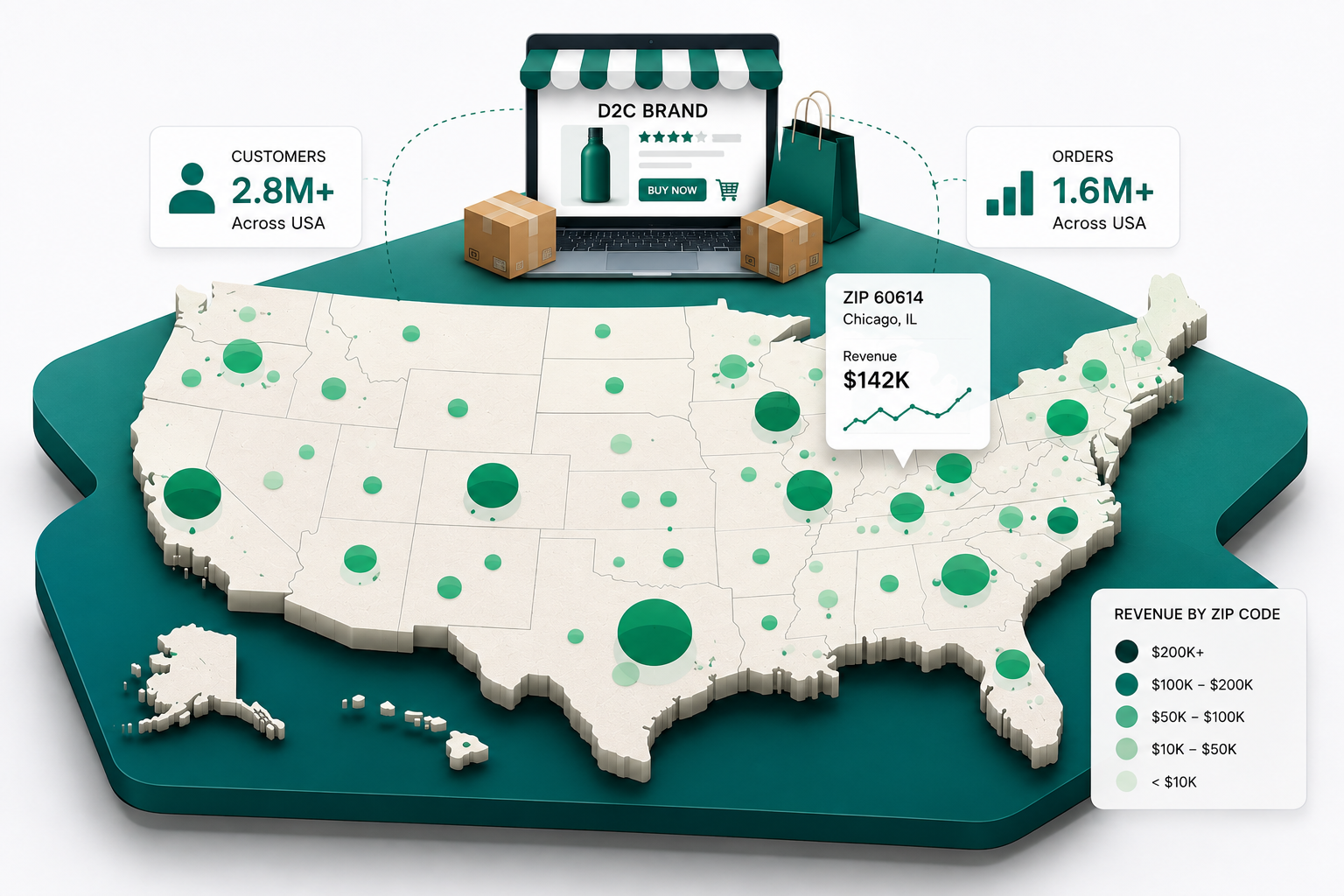
They pull up their sales dashboard and point at three glowing dots on the US map — usually Austin, LA, Miami, sometimes Denver or NYC. “That’s where we’re strong,” they tell me. “We’re doubling down there next quarter.”
I’ve started asking one question in reply:
“How do you know you’re strong in Austin — or is Austin just where you started?”
Because those two things look identical on a map. A ZIP doing well because it fits your product looks exactly the same as a ZIP doing well because it was your friend group, your first podcast, your launch city. Same shade of green. Same revenue. Different story entirely.
That’s the map problem. And it’s quietly costing you money you don’t know you’re losing.
The layer we’ve ignored
For a decade, e-commerce has gotten stupidly good at two things.
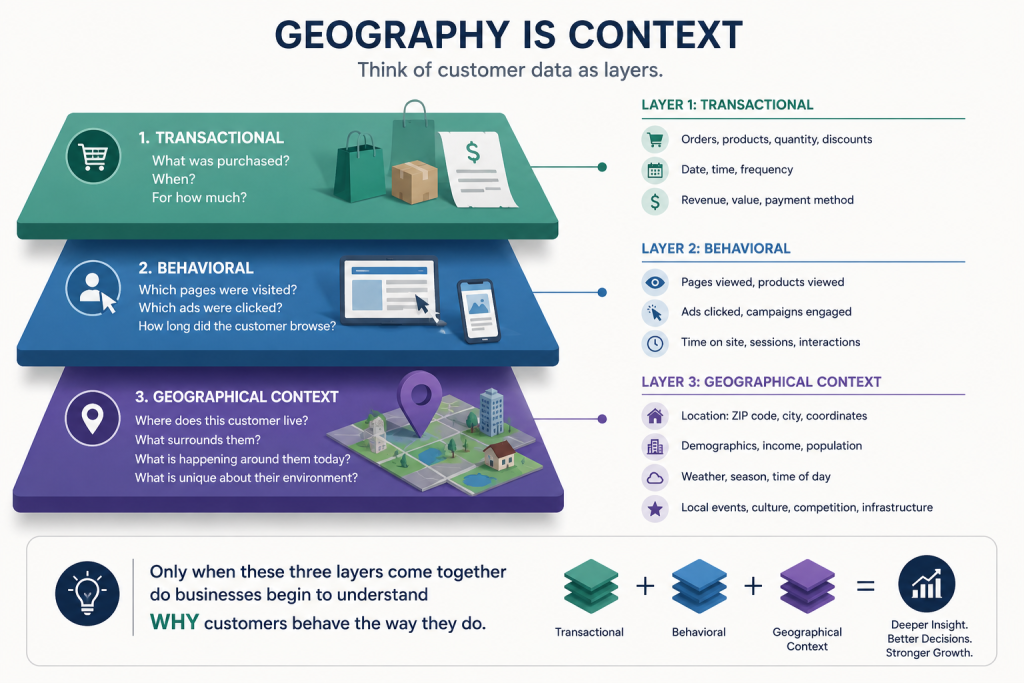
Transactional data. LTV, AOV, repeat rate, cohorts. Every founder can pull these in ten seconds.
Behavioral data. Clicks, sessions, attribution, email opens. We know every micro-move a customer makes on our site.
But between the moment they close the browser tab and the moment they open it again the next day, we know almost nothing.
We know they clicked. We don’t know if it rained where they live. We know they bought. We don’t know if the neighborhood next to them is 3× denser with the same demographic. We know their LTV. We don’t know if half the country still hasn’t seen a single one of our ads.
That’s the missing layer. Geographic intelligence — the physical, demographic, and economic context in which your customers actually live and make decisions.
It’s what turns a sales map from a rear-view mirror into a compass.
Two ZIP codes
Imagine two ZIPs. Both did $12,000 last month. Same product mix, same AOV. On your dashboard, identical.
ZIP #1 is in West LA. Median income $180K. 4,000 households. You’re already at 8% penetration. Ad costs are brutal. Every incremental order will get more expensive.
ZIP #2 is a suburb of Columbus, Ohio. Median income $95K — solidly your buyer. 6,200 households. You’re at 0.4% penetration. Ad costs are a third of LA. Every incremental order will get cheaper.
Same revenue last month. Completely different next quarter. One is a mature market; one is a market you haven’t started. Your dashboard can’t tell you which is which. Only geography can.
Now multiply that by 33,000 US ZIP codes. That’s the size of the blind spot.
The way to close it is a framework I’ve been calling the 4Ps of Geo Intelligence – Place, People, Prosperity, and Pulse. The physical environment, who lives there, what they can afford, and what’s happening in the market right now. Each one deserves its own post, and I’ll write them. For now, the point is: geography is not a heatmap. It’s a system of context.
Why this compounds
Here’s the part I want every founder to internalize.
Your ad spend compounds your penetration bias. Every Meta lookalike you build is anchored to your existing customer list. Which means every new dollar chases people who look like the ones you already found. Which is fine — until you realize “the ones you already found” is heavily biased by which cities you launched in, which podcasts you sponsored, which subreddit noticed you first.
The dark ZIPs on your map didn’t stay dark because they don’t fit. They stayed dark because you never showed up. And your ad platform, left to its own devices, will never send you there.
What we’re building
VisualVerb connects to your store and gives you two maps: where you sell today and where you should sell next. Every ZIP enriched with demographics, income, and density – so you can see the difference between a saturated market and one you haven’t started, at a glance.
If you’re a D2C brand and this problem is real for you, I’d like to give you the map for free.
I’ll trade you: you get the map, I get to learn from what you find in it.
Your sales map is not a report card. It’s a compass. But only if you can read what the shading is actually telling you.
A ZIP glowing bright green might be a market you own. Or it might be one you started in, coasting on early tailwinds while the rest of the country you could own sits invisible.
A ZIP sitting dark might be a bad fit. Or it might be your next Austin, waiting.
Every purchase has a location. Every customer has a neighborhood. The next competitive edge in D2C isn’t more customer data.
It’s context.
Geography is where the context lives.