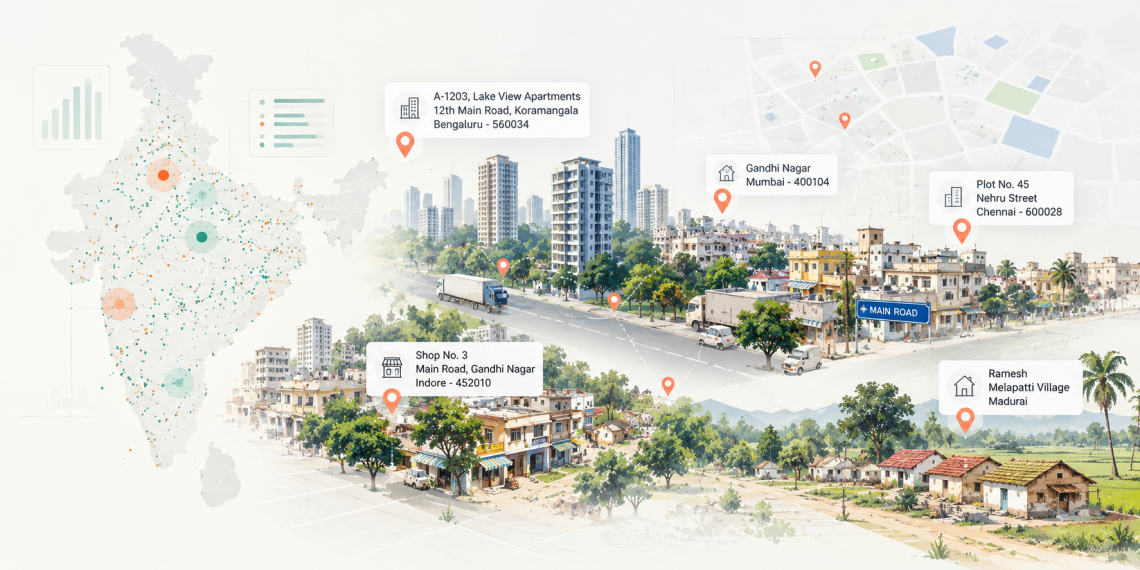
Beyond PIN Codes: Understanding the Complexity of Indian Geography
Once we were done with Where to Sell Next for the US market, I started working on the same problem for the Indian market.
The Indian market is not for beginners.
It all started with PIN codes, which, at least to our understanding, are equivalent to ZIP codes in the US. But we soon realised that PIN codes are too large to be considered a homogeneous geographic unit that can be used for business decision-making.
So, we decided to understand the whole thing from the ground up. We went back to the smallest possible business-related geographic unit: an address or a location.
Now, we also know that an address in India is not straightforward.
During our research, we realised that addresses are hardly standardised. In fact, they are not even standardised within a Pincode. This creates a lot of problems and costs for businesses, especially delivery-based businesses like eCommerce and logistics companies. The more we looked into it, the bigger and more foundational the problem appeared.
Our original objective was to define smaller and more homogeneous geographic areas, and then build socio-economic and other parameters around these newly defined areas.
Since PIN codes were not granular enough for this purpose, we needed a new way of defining these basic geographic units. Something similar to a PIN code, but smaller and more homogeneous in nature, while still covering a significant enough population to make it useful for business decision-making. At the same time, the structure and the underlying logic had to be scalable across India.
This itself is a fairly complex problem.
So, before going after something this complex, we decided to take a step back and solve another complex problem first. One that would also give us a better understanding of India, its geography, and the data associated with it.
We decided to start with address standardisation and address validation.
But during our research, we figured out that this is not straightforward either.
Address standardisation is not just about correcting spelling mistakes, fixing formatting, or making an address follow a particular structure. It has multiple components, and each component itself is a complex problem.
We described the problem we faced to an LLM only for the city-based addresses, and we came up with the image below.
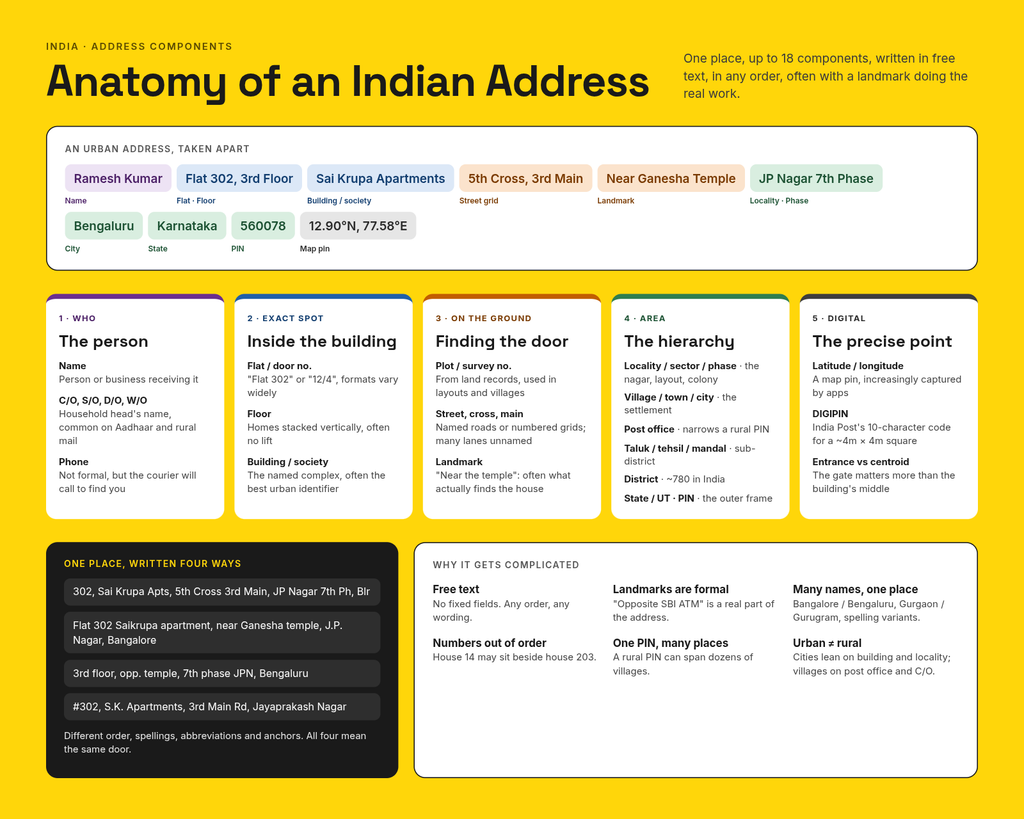
Further research led to this realisation -> Indian addresses deserve a case study of their own. 😄
In a Tier 1 city, you might need an apartment number, building name, street, locality, landmark, and PIN code. In a village? Sometimes, the person’s name and village name are enough!
And then come the plot twists:
- Every city seems to have a Gandhi Nagar, a Nehru Street, and a Main Road.
- Someone who has lived in a locality for 20 years might still not know its PIN code
- A place is popularly known as X, but its PIN code belongs to Y – an area people may not even associate it with.
- Address components that matter in a metro may be completely irrelevant in a small town or village.
Funny? Yes. Expensive? Absolutely.
India handles billions of e-commerce shipments every year. Industry estimates suggest that address errors account for 18–24% of Return-to-Origin (RTO) shipments, with a direct logistics cost of approximately ₹180 – ₹240 per RTO.
Using these estimates alongside an overall RTO-rate scenario, the address-error-related logistics bill could run into thousands of crores annually across prepaid and COD orders. And this doesn’t include the cost of extra delivery attempts, customer support calls, delayed deliveries, or lost customers.
The real question is: how much of this could be avoided if technology understood Indian addresses the way local people understand them? Maybe we need to move beyond address validation.
We need address intelligence – technology that understands local context, not just matching strings and PIN codes.
Because in India, getting an address technically correct doesn’t always mean getting the location right.
#Logistics #Ecommerce #India #GeospatialIntelligence #AddressIntelligence